Will LED Light Strips Overheat? Prevention & Heat Dissipation Solutions for B2B Projects
1. Normal Heat vs Overheating: LED Strip Temperature Standard
Proper heat generation is normal for LED light strips, while excessive temperature will cause light decay, color shift and dead lights. For B2B commercial, engineering and OEM projects, we adopt unified industrial temperature evaluation standards:
| Temperature Grade | Surface Temperature | Operating Status & Risk | B2B Operation Suggestion |
| Safe Normal Temperature | ≤43°C | Mild warmth, no scalding feeling, stable light output, negligible aging | Long-term continuous operation is allowed |
| Critical Warning Temperature | 43°C – 60°C | Accelerated component aging, hidden risk of light decay | Optimize heat dissipation and reduce load power |
| Overheating Fault | >60°C | Color shift, local blackening, dead lights, insulation aging | Stop operation immediately and troubleshoot |
2. LED Strip Overheating Causes & Targeted Solutions
Most B2B on-site overheating problems come from mismatched materials, non-standard power supply and irregular installation. The table below summarizes all core causes and one-to-one solutions to simplify project debugging:
| Overheating Root Cause | Specific Problem Performance | B2B Professional Solution |
| Low thermal conductivity substrate | FR-4 fiberglass board used for high-power strips, heat cannot be exported quickly | Adopt MCPCB aluminum substrate / 2oz thick copper foil for projects above 12W/m |
| Mismatched driver power | Overvoltage, insufficient power margin, non-standard driver overload | Reserve 20%+ power margin, use factory-matched isolated drivers |
| No heat dissipation profile | Bare sticking leads to heat accumulation, especially for COB high-density strips | Equip 6063-T5 aluminum channel, use thermal conductive adhesive/pads |
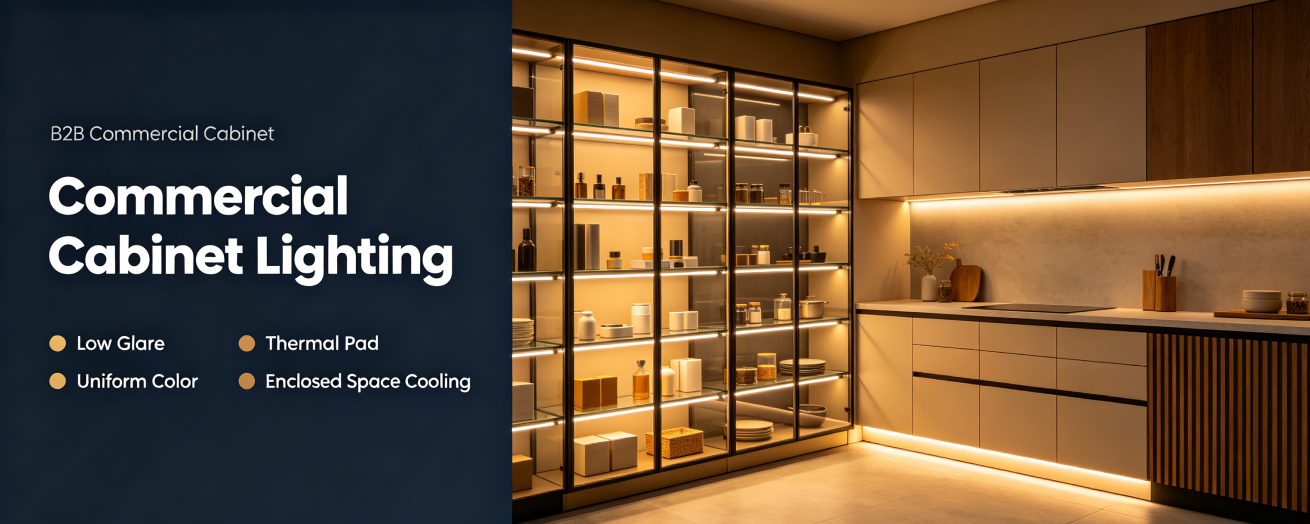
| Closed & poor ventilation environment | Cabinet, sealed light box, no air convection, heat trapped | Reserve ventilation gaps or install silent cooling fans |
| Excessive power density | High-power strips used in narrow enclosed grooves beyond heat load | Match power by scenario; limit enclosed space power within 12W/m |
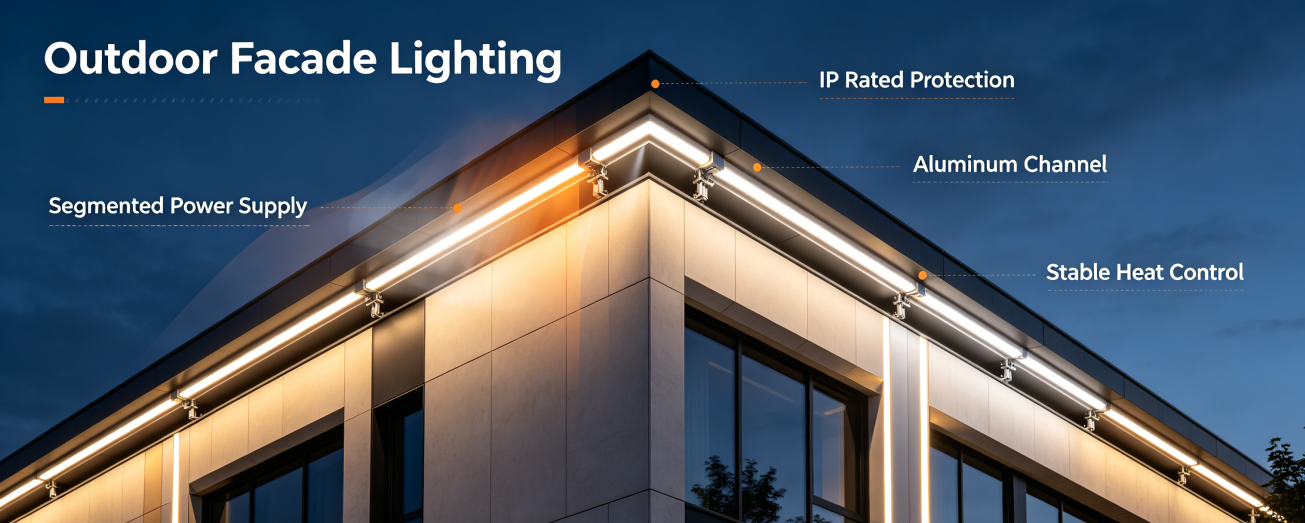
| Overlong wiring & voltage drop | Low-voltage strip over-lengthened, terminal current unbalanced and overheated | Implement segmented power supply, control single running length |
3. Core Risks of Overheated LED Strips in B2B Projects
Continuous overheating is the main cause of high after-sales rate and project unqualified acceptance in commercial lighting engineering. The main risks include accelerated luminous decay, color temperature shift, circuit component damage, reduced safety margin, and damaged project reputation for bulk OEM and chain store projects. Stable thermal management is the key to ensuring long-term reliability of B2B lighting projects.
4. B2B Scene-based Selection & Heat Dissipation Matching Guide
Reasonable power matching and heat dissipation configuration according to application scenarios can fundamentally avoid LED strip overheating, suitable for engineering procurement, design institute selection and OEM customized projects:
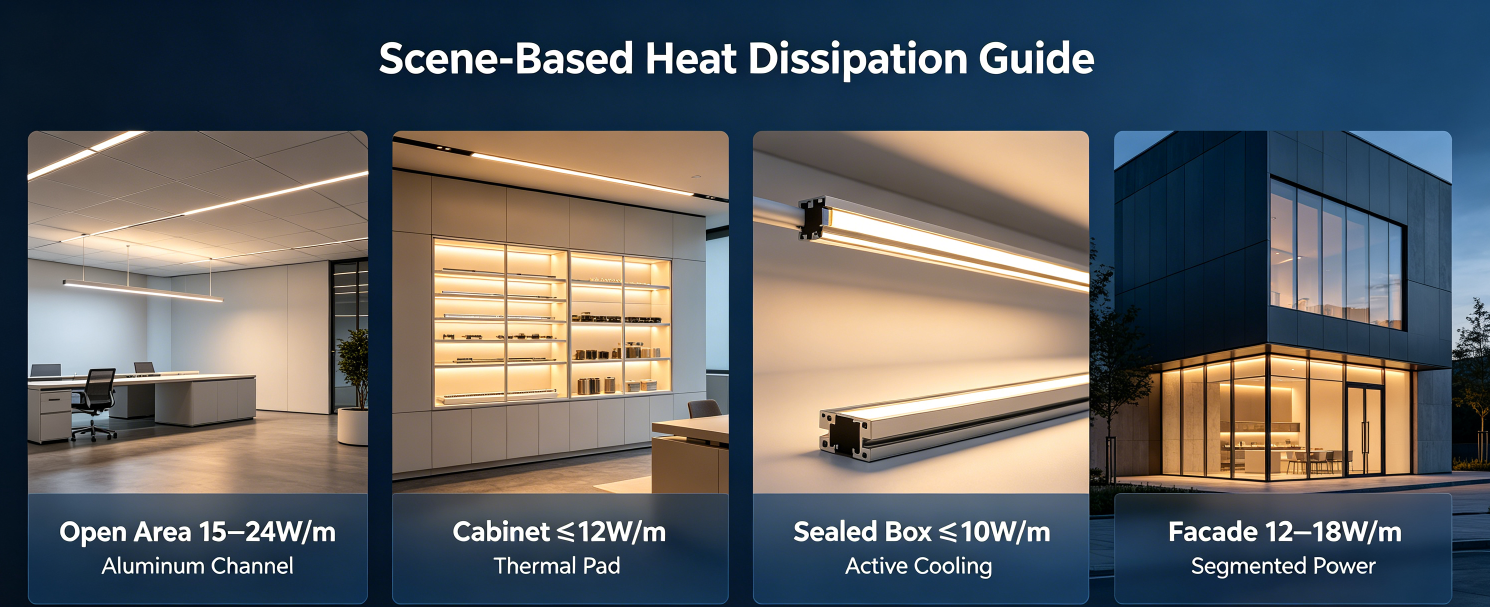
| Application Scenario | Recommended Power Density | Matching Heat Dissipation Solution |
| Open ceiling / exterior wall open installation | 15–24W/m High-power COB/SMD | Standard thickened aluminum channel + natural air convection |
| Cabinet / enclosed acrylic light groove | ≤12W/m Low-power strip | Thin-wall aluminum profile + thermal conductive pad + reserved ventilation gap |
| Sealed light box / industrial equipment interior | ≤10W/m Low power, wide temperature resistant type | Fin-type heat dissipation profile + active cooling fan |
| Outdoor facade & long-distance lighting | 12–18W/m Engineering-grade strip | Thick aluminum channel + segmented power supply + IP waterproof & heat resistant sleeve |
5. On-site Installation Specification & Anti-overheating Checklist
Standard construction can effectively reduce hidden heat accumulation risks. We sorted B2B engineering universal construction rules into a simple checklist:
| Installation Item | Standard Requirement | Prohibited Operation |
| Mounting base | Adopt metal, cement and other high thermal conductivity substrates | Large-area direct pasting on foam, wood, plastic |
| Light groove space | Reserve ≥5mm ventilation gap | Fully enclosed and completely sealed cover |
| Strip spacing | Keep ≥3cm gap between multiple strips | Closely arranged overlapping heat accumulation |
| Wiring design | 12V/24V follow standard length + segmented power supply | Ultra-long single-line power supply |
6. Custom Thermal Management Solutions for Special Scenarios
For high-power, high-temperature and fully enclosed B2B bulk projects, we provide one-stop customized thermal management supporting solutions, including upgraded widened aluminum substrate strips, high-temperature resistant silicone sleeves, CFD thermal simulation testing, matched heat dissipation aluminum profiles and overheat protection drivers. All products support pre-delivery aging test and parameter report output to meet engineering acceptance and OEM export standards.
7. Final B2B Bulk Order Thermal Control Checklist
1. Match strip power density according to installation airtightness;
2. Use aluminum substrate strips + aluminum channel for power above 12W/m;
3. All drivers reserve 20% power margin to avoid overload;
4. Standardize thermal conductive accessories and ventilation construction;
5. Adopt segmented power supply for long-distance lighting projects;
6. Complete sample temperature rise test before mass production.
Scientific thermal management can stabilize the lighting effect, reduce light decay and failure rate, and greatly reduce the after-sales operation and maintenance cost of B2B engineering and bulk order projects, which is an essential part of professional LED strip lighting system solutions.
Contact us if you have any other questions about LED strip lights!
Facebook:https://www.facebook.com/profile.php?id=100089993887545
Instagram:https://www.instagram.com/mingxuelighting.factory/
YouTube:https://www.youtube.com/channel/UCMGxjM8gU0IOchPdYJ9Qt_w
LinkedIn:https://www.linkedin.com/company/mingxue/