- Home
- News
- LED Strip Lights vs Regular Bulbs: What Are the Differences? | B2B Commercial Lighting Selection Guide
LED Strip Lights vs Regular Bulbs: What Are the Differences? | B2B Commercial Lighting Selection Guide
In commercial lighting, engineering lighting projects, interior decoration, and precision ambient lighting scenarios, many bulk buyers, engineering contractors, and business clients often wonder: what are the differences between LED strip lights and regular bulbs, and which is better for commercial use? As two mainstream lighting solutions for residential and commercial use, LED strip lights and regular bulbs differ greatly in luminous principle, installation flexibility, lighting performance, energy consumption, service life, and commercial applicability. Mastering the key differences between LED strips and traditional bulbs helps B2B buyers select cost-effective, long-lasting lighting solutions for various engineering and bulk procurement projects.
Regular bulbs mainly refer to traditional incandescent bulbs, halogen bulbs, and standard LED bulb lamps, classic fixed light sources designed for basic and general lighting. In contrast, flexible LED strip lights are modular, customizable, lightweight modern lighting solutions tailored for high-end scenarios. With outstanding flexibility, low power consumption, ultra-long lifespan, and adjustable lighting effects, LED strips have become the preferred alternative to traditional regular bulbs, dominating B2B commercial lighting, architectural decoration, and customized illumination projects.
This article comprehensively compares LED strip lights and regular bulbs from core specifications, practical application scenarios, energy-saving efficiency, and commercial cost performance dimensions. By clarifying the actual gap between LED strips and traditional bulbs, it helps B2B enterprises, project contractors, and brand suppliers complete accurate lighting selection, avoid improper specification matching, and reduce unnecessary engineering and operating costs.
1. Core Definition: Essential Differences Between the Two Light Sources
1.1 Regular Bulbs (Traditional Light Sources)
Regular bulbs include incandescent lamps, halogen lamps, and standard LED bulb lights. Featuring a fixed spherical structure and threaded/socket mounting design, they belong to fixed-point light sources with a constant beam angle. Their main advantages are simple installation and plug-and-play usability. However, they rely on standard lamp bases with low plasticity and single lighting performance, mostly used for basic residential lighting and general commercial auxiliary lighting.
1.2 LED Strip Lights (Flexible LED Light Strips)
LED strip lights are linear surface light sources composed of SMD LED beads mounted on flexible FPC circuit boards. They support free cutting, bending, and fitting irregular surfaces, and can be matched with dimming, color tuning, and intelligent control systems for customized lighting effects. Focusing on recessed lighting, ambient decoration, precision supplementary lighting, and architectural contour lighting, LED strips are core products for high-end B2B commercial spaces and customized engineering projects.
2. Full Comparison: LED Strip Lights vs Regular Bulbs
To facilitate fast and accurate B2B lighting selection, we have sorted out a detailed performance comparison between LED strip lights and regular bulbs, covering core parameters, practical performance, and long-term commercial value. All comparison data conforms to universal industry standards without exaggerated promotion, providing compliant and reliable references for commercial bulk procurement and engineering lighting projects.
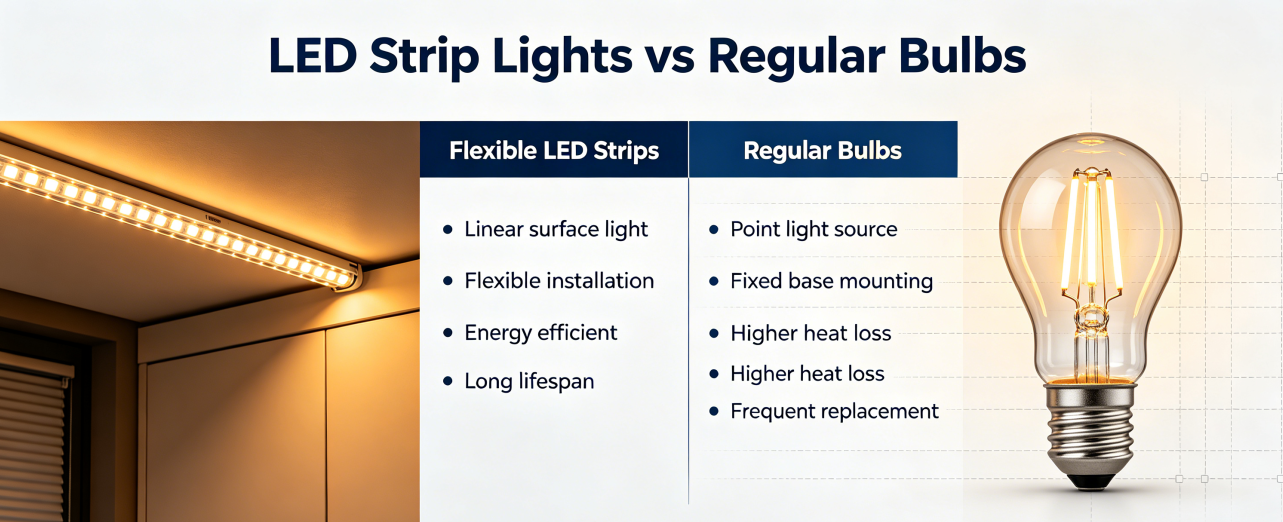
| Comparison Dimension | Regular Bulbs (Incandescent / LED Bulbs) | Flexible LED Strip Lights | B2B Commercial Advantage |
| Light Source Type | Point light source, concentrated local brightness, uneven illumination | Linear surface light source, uniform brightness, no dark areas, no glare | LED Strip Lights (Precision Lighting) |
| Installation Form | Fixed base mounting, single structure, unable to adapt to irregular spaces | Flexible & bendable, customizable cutting, fits ceilings, cabinets, curved surfaces, supports recessed installation | LED Strip Lights |
| Beam Angle | 180° wide-angle emission, scattered light, easy to cause light pollution | 120° directional lighting, high light utilization rate, low light loss | LED Strip Lights |
| Energy Efficiency | High power consumption, high long-term operational electricity cost under equal brightness | Low power & high efficiency, saves over 60% energy compared with regular bulbs, ideal for long-hour commercial operation | LED Strip Lights |
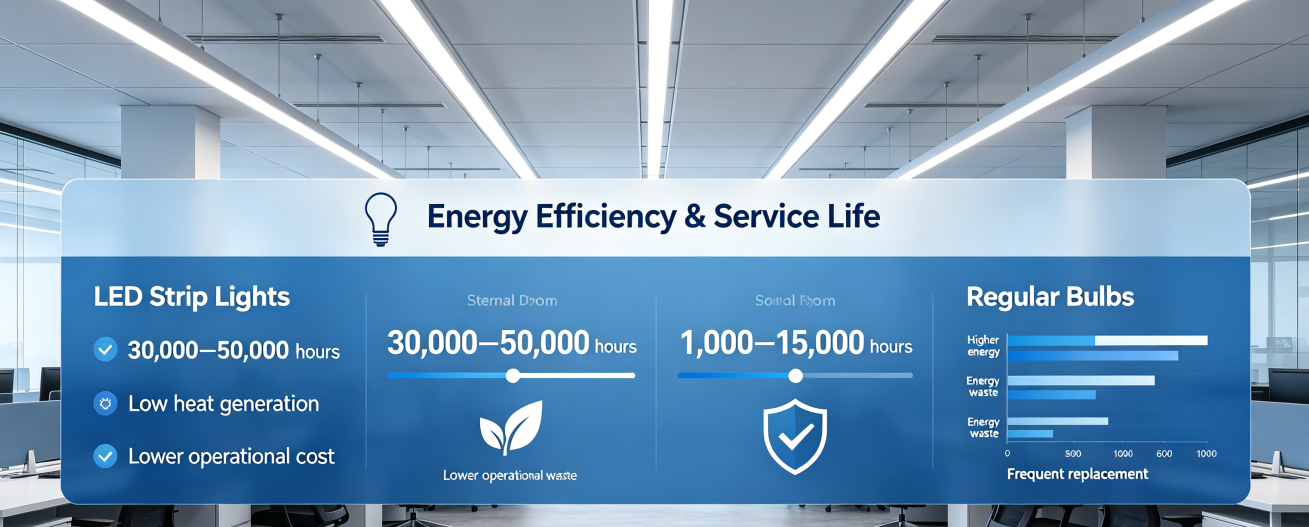
| Service Life | 1,000-5,000 hours for incandescent/halogen bulbs; around 15,000 hours for standard LED bulbs | 30,000-50,000 hours for industrial-grade LED strips, low failure rate, low maintenance cost | LED Strip Lights |
| Lighting Effect | Fixed single color, single layer lighting, no ambient customization capability | Supports warm white, cool white, RGB colorful, dimming & color tuning, multi-layer ambient lighting | LED Strip Lights |
| Maintenance Cost | Prone to burnout, frequent replacement required, high labor & material cost for batch commercial use | Modular structure, partial damage replacement available, low overall operation & maintenance cost | LED Strip Lights |
| Procurement Cost | Low unit price, low short-term investment | Slightly higher unit price, higher comprehensive cost performance in energy saving, maintenance and aesthetic value | Regular Bulbs (Short-term Temporary Lighting) |
3. Four Core Differences for Commercial Lighting Selection
3.1 Scene Adaptability: Standard Fixed Lighting vs Customized Flexible Lighting
As standardized fixed-point light sources, regular bulbs are only suitable for single basic general lighting in homes, ordinary workshops, and conventional rooms. The biggest limitation of traditional bulbs is poor scene adaptability, which makes them unable to fit special-shaped ceilings, display cabinets, wall outlines, stair treads and other irregular spaces. The rigid lighting effect lacks layering and cannot meet the aesthetic and display needs of high-end commercial spaces, a key shortcoming compared with LED strip lights.
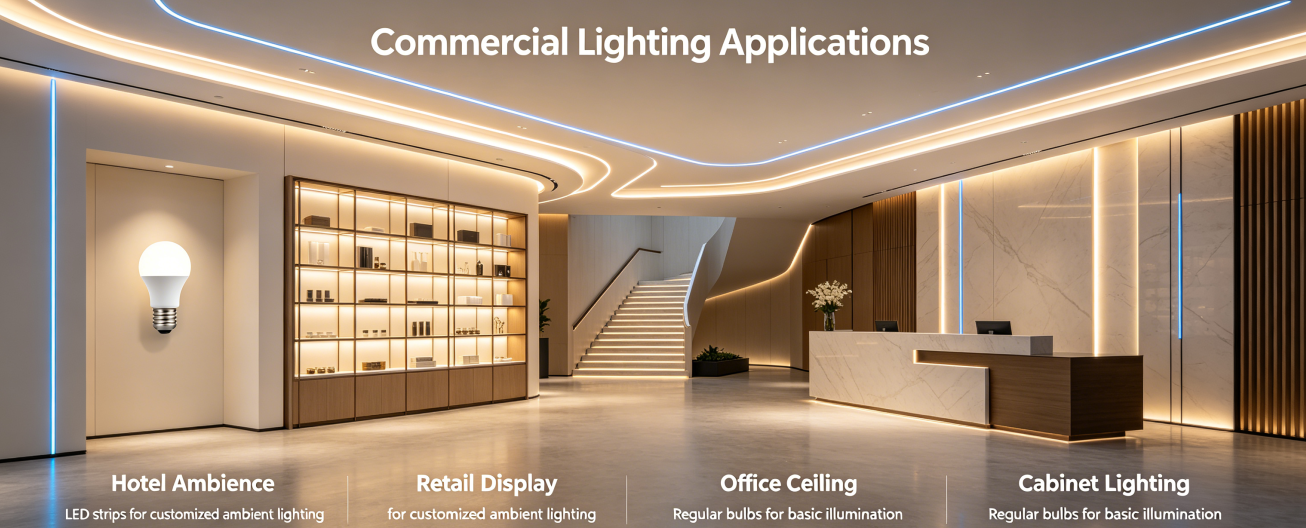
Benefiting from flexible bending, customizable cutting and hidden installation features, LED strip lights perfectly solve the adaptability pain points of regular bulbs. LED strips specialize in precision auxiliary lighting, ambient decoration, display lighting and architectural outline lighting, and can perfectly fit commercial exhibition halls, hotels, shopping mall displays, office ceilings, building outline lighting, cabinet lighting and other customized scenarios. The unique “invisible light, visible glow” lighting effect makes LED strips the preferred material for commercial space upgrading and engineering lighting projects.
3.2 Operational Energy Consumption: High Loss Short Lifespan vs Energy-Saving Durability
For B2B commercial complexes, chain stores, factories and other scenarios requiring long-term uninterrupted lighting, the energy consumption and service life of light sources directly determine overall operation costs. Traditional incandescent and halogen regular bulbs generate huge heat with low photoelectric conversion efficiency; most electric energy is converted into heat loss rather than luminous energy. This leads to high power consumption, easy light aging and frequent burnout, bringing continuous high electricity and replacement costs for enterprise operation, which is far less economical than LED strip lights.
Different from energy-wasting regular bulbs, LED strip lights adopt solid-state photoelectric lighting technology, with low heat generation and high energy conversion efficiency. Without fragile filaments or vulnerable structures, LED strips deliver stable long-term performance. Industrial-grade LED strips are equipped with professional heat dissipation design, effectively resisting light decay during long-hour operation, perfectly meeting commercial all-weather lighting needs and greatly reducing enterprise operation and maintenance costs.
3.3 Commercial Value: Basic Illumination vs Value-Added Ambient Lighting
Regular bulbs only provide basic brightness coverage with harsh light and poor uniformity. They merely meet the simplest “lighting” demand without spatial layering and decorative value, unable to improve the grade and commercial appeal of venues.
In contrast, LED strip lights deliver soft, uniform, flicker-free and glare-free lighting that regular bulbs cannot match. The customizable color temperature, brightness and dynamic RGB lighting effects of LED strips can not only optimize overall space brightness uniformity, but also enhance commercial space grade through layered ambient lighting. This unique commercial value makes LED strips widely applied in chain brand stores, high-end interior decoration and cultural tourism lighting B2B projects.
3.4 Construction Compatibility: Simple Installation vs Engineering-Grade Adaptability
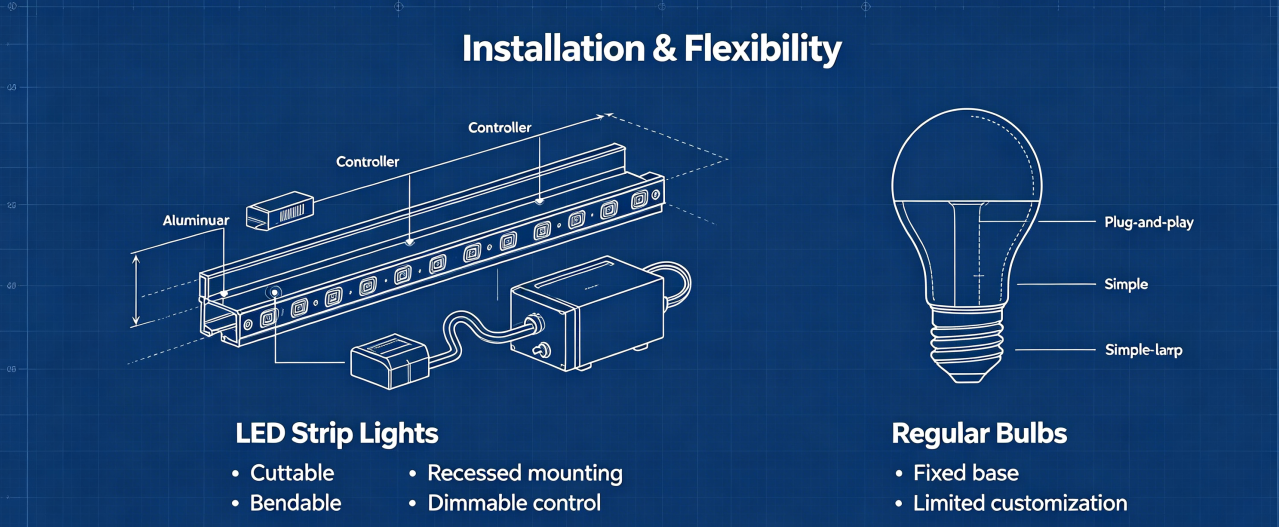
Regular bulbs support only simple plug-and-play installation, suitable for basic household lamp replacement. However, traditional bulbs have fixed structures with zero customization ability, unable to adapt to batch engineering construction and special-shaped space construction, which cannot meet personalized B2B project demands.
LED strip lights make up for the construction defects of regular bulbs perfectly. LED strips support free batch cutting, flexible splicing and safe low-voltage construction. Matched with aluminum channels, controllers and transformers, they are compatible with various indoor and outdoor engineering scenarios. Supporting standardized batch construction and personalized customized construction, LED strips fully meet B2B bulk procurement, interior engineering and lighting project delivery requirements for various scale projects.
4. Applicable Scenarios for Accurate B2B Selection
Scenarios Suitable for Regular Bulbs
- Basic residential lighting and simple replacement of old lamps
- Temporary emergency lighting and short-term construction site supplementary lighting
- Warehouse and storage space lighting with low requirements for lighting effect and aesthetics
Scenarios Suitable for LED Strip Lights
- Commercial spaces: Ambient lighting for hotels, shopping malls, exhibition halls, chain stores and high-end offices
- Display lighting: Precision supplementary lighting for display cabinets, wine cabinets, wardrobes and exhibition stands
- Engineering lighting: Outdoor landscape lighting for building outlines, bridges, pedestrian paths and cultural tourism projects
- Custom lighting: Recessed hidden lighting for special-shaped ceilings and curved structures
- B2B batch projects: Unified lighting upgrading for chain brands and bulk supporting supply for interior projects
We have sorted out standardized and compliant answers to high-frequency questions from global bulk buyers and engineering contractors, focusing on core search demands about LED strip lights vs regular bulbs, to solve your lighting selection confusion.
Q1: Are LED strip lights more energy-saving than regular bulbs?
Yes. Under the same luminous brightness, LED strip lights consume far less power than incandescent and halogen bulbs, and achieve more than 30% energy saving compared with standard regular LED bulbs. With low heat generation and stable anti-light-decay performance, they maintain low energy consumption during long-term operation, making them ideal for commercial continuous lighting scenarios.
Q2: Can LED strip lights completely replace regular bulbs?
Complete replacement is not applicable; the two light sources are complementary. Regular bulbs are suitable for standardized main lighting with simple demands. LED strip lights focus on customized auxiliary lighting and ambient decorative lighting. Most high-end commercial projects adopt the combined solution of “main bulb lighting + LED strip ambient lighting” to balance basic brightness and spatial texture.
Q3: Which is more cost-effective for commercial projects, LED strips or regular bulbs?
LED strip lights deliver higher comprehensive cost performance for long-term commercial operation. Despite a slightly higher initial procurement cost, they greatly reduce later-stage electricity expenses, replacement frequency and maintenance labor costs with longer service life and lower energy consumption. Regular bulbs are more cost-effective only for short-term temporary lighting projects.
Q4: Are LED strip lights difficult to install? Are they suitable for B2B bulk procurement?
Conventional low-voltage LED strip lights feature safe and simple installation, and can be constructed in batches with matched aluminum channel accessories. Our factory provides one-stop B2B services including customized cutting, unified packaging, technical guidance and engineering scheme docking, supporting small-batch trial orders, large-batch bulk supply and cross-border OEM/ODM cooperation.
Q5: Do LED strip lights have a longer service life than regular bulbs?
High-quality industrial-grade LED strip lights have a service life of 30,000 to 50,000 hours, far exceeding incandescent and halogen bulbs and conventional regular LED bulbs. Featuring stable modular structure, vibration resistance and aging resistance, they present lower failure rate and higher durability in long-term commercial engineering applications.
5. Conclusion: Scientific Selection for B2B Commercial Lighting Projects
In summary, regular bulbs are basic general lighting products, with only simple installation and low unit price advantages, only applicable to simple and low-demand basic lighting scenarios. In contrast, LED strip lights are engineering-grade customized lighting products, with prominent advantages in energy saving, durability, lighting effect diversity and scene adaptability. The obvious comprehensive performance gap between LED strips and regular bulbs makes LED strips the mainstream choice for modern commercial lighting and engineering customized projects.
As a professional LED strip light manufacturer, we focus on B2B engineering customization, bulk wholesale and cross-border OEM/ODM services. We supply a full range of products including high-voltage/low-voltage, single-color/RGB/intelligent dimmable, indoor/waterproof outdoor LED strips. We provide customized parameter adjustment, professional lighting scheme design and after-sales technical support for global engineering contractors and bulk buyers, delivering high-quality and cost-effective commercial lighting solutions.
Facebook:https://www.facebook.com/profile.php?id=100089993887545
Instagram:https://www.instagram.com/mingxuelighting.factory/
YouTube:https://www.youtube.com/channel/UCMGxjM8gU0IOchPdYJ9Qt_w
LinkedIn:https://www.linkedin.com/company/mingxue/